AI adoption exposes a resilience gap in UK industry

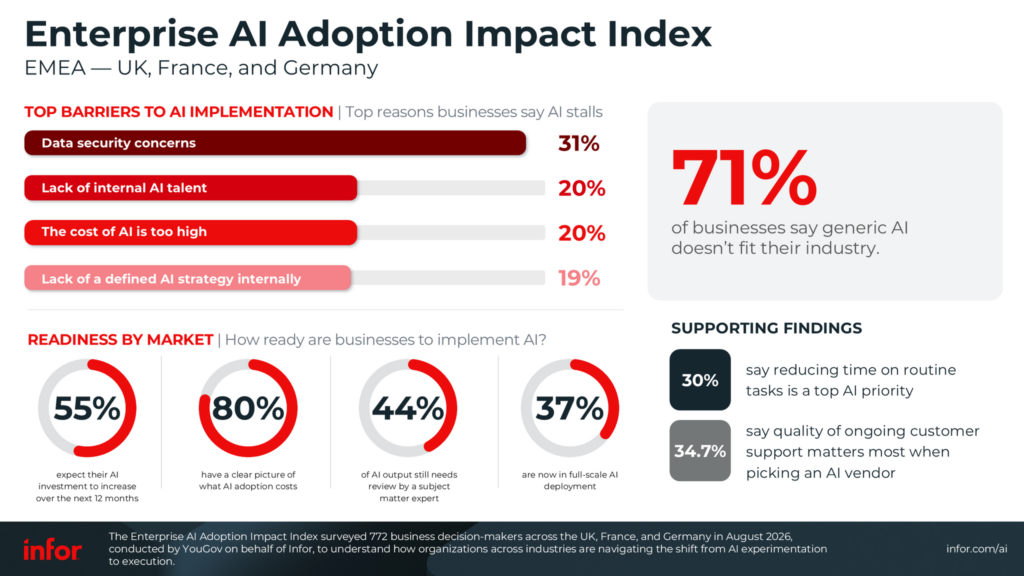
Artificial intelligence is becoming more common in UK operations, yet the country is struggling to convert deployment into the efficiency gains reported elsewhere. The second wave of Infor’s Enterprise AI Adoption Impact Index surveyed more than 2,100 senior business leaders and AI decision-makers across seven markets.
UK businesses reported a 23% average efficiency improvement during the past year, compared with 34% across the other six countries. For manufacturers, distributors and retailers, the result highlights a familiar Industry 5.0 challenge: digital tools must strengthen operational resilience and human decision-making rather than add another layer of complexity.
Deployment is not the same as readiness
Full AI deployment in the UK rose from 21.8% to 23.6%, and more than 60% of companies are running AI in some form when partial deployments are included. Half expect to raise investment over the next 12 months. Nevertheless, confidence in implementing AI without disrupting operations fell from 75% to 66%.
Trust in autonomous operation is particularly limited. Only 6.3% of respondents are comfortable allowing agents to manage processes ranging from routine to critical, down from 11.7%. Human review is still required by 53% of UK respondents. This points to a demand for automation that remains explainable, auditable and connected to accountable operators.
Businesses are focusing on measurable industrial outcomes: reducing routine work, lowering operating costs and automating workflows. But 67% say generic solutions do not meet the needs of their business or sector. A standard model introduced without process knowledge can increase integration work and weaken confidence instead of improving productivity.
The infrastructure behind responsible automation
Only 62% of UK companies consider their data mature and well governed enough to support dependable AI. Legacy or disconnected systems increased integration and readiness costs for 24% of respondents and delayed deployment for 22%. These weaknesses directly affect the ability to scale automation across production, supply and service operations.
Governance is another gap. Fourteen percent said no single person is responsible for AI use, risk and compliance, while 28% cited regulatory uncertainty. Smaller companies face a steeper barrier: 40% have no AI deployment of any kind, compared with 9% of large firms.
The findings favour an Industry 5.0 approach built around specific workflows, clean data and human accountability. Industry-specific AI agents, monitoring and audit controls can help organisations pursue productivity while preserving operational oversight and resilience.