ALDO Extends Integrated Logistics Model with Bleckmann

The ALDO Group is extending its logistics partnership with Bleckmann until July 2031. The Canadian footwear and accessories retailer has relied on Bleckmann since July 2016 for a connected set of supply-chain services.
The contract includes transport, warehousing, customs and freight. Rather than treating these activities as isolated functions, the partnership links them through daily coordination between the two companies. That structure is particularly relevant to a retailer serving multiple international markets, where delays or gaps between logistics processes can quickly affect availability.
Scale and cross-border complexity
Bleckmann’s primary responsibility is ALDO’s European logistics and warehousing. The operation also exports products to Morocco, Egypt, Angola, Albania, Turkey, Cyprus and the United Kingdom. Poland, Germany, France and Portugal are among the retailer’s important European destinations.
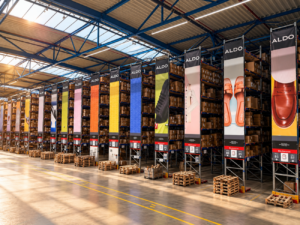
Approximately 3.2 million items are shipped from the Enschede warehouse each year. This volume gives process consistency and rapid operational communication a practical role in maintaining the flow of products across borders.
Continuity with scope for improvement
The partners describe their relationship as stable and focused on mutual trust, continuous improvement and cost savings. The renewal therefore offers resilience through continuity: ALDO keeps an established logistics framework, while Bleckmann continues to refine the associated warehouse and distribution processes.
The agreement also illustrates a pragmatic Industry 5.0 principle. Digital and operational improvements do not have to begin with a wholesale replacement of the supply chain. In a mature partnership, performance can be improved incrementally through closer collaboration, better coordination and disciplined process management.
For international retailers and industrial supply-chain leaders, the case underlines the importance of integrating logistics capabilities across the physical network. A long-term contract alone does not guarantee efficiency, but a stable partnership can create the conditions for measurable operational improvement without disrupting service continuity.