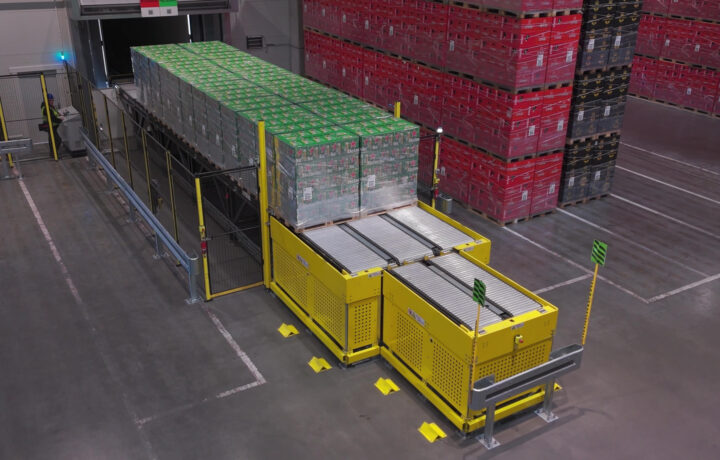
Warehouse automation has made rapid progress in storage, sorting and picking, but the loading bay has remained a less standardised frontier. STILL and Colruyt Group are addressing that gap with the AXL iGo, an autonomous low-lift pallet truck that moves goods between lorries and the dock without a stationary safety system.
The project received the 2026 ALICE Logistics Innovation Award at the ALICE Logistics Innovation Summit in Brussels on 17 November. The award is intended for innovations that demonstrate how publicly supported research can become a deployable industrial capability, with measurable benefits and scope for wider uptake.
From fixed automation to adaptable operations
Vehicle loading is difficult to automate because dock layouts, trailer positions and operating conditions are less uniform than those inside a warehouse. The AXL iGo is designed to operate in that variable interface without requiring a permanent safety installation. STILL describes it as the first market-ready, series-produced solution of its kind.
For Industry 5.0-oriented operations, the significance is practical rather than merely demonstrative. A system that can be introduced into an existing logistics environment may allow companies to improve process consistency without redesigning an entire facility around fixed automation. It can also reduce manual pallet movement in an area where people and vehicles work in close proximity.
Operational evidence from a retailer network
The technology was developed with Colruyt Group and subjected to extensive testing in the retailer’s logistics network. After being integrated into live warehouse operations in 2026, the vehicle had moved more than 200,000 pallets autonomously.
Trials have expanded to sites in the Netherlands, Germany, France and Spain. This geographical spread is important for assessing how the concept performs across different facilities and workflows, although the source material does not quantify efficiency or labour savings.
A wider automation trajectory
The award follows the AXL iGo’s receipt of the LOGISTRA Innovation Award 2026. Both recognitions point to a wider industrial trend: automation is increasingly being evaluated as a way to make complete material flows more resilient and predictable, rather than as a collection of isolated warehouse tasks.
By targeting the vehicle-to-dock transfer, STILL and Colruyt Group are extending autonomous logistics into one of the last major manual interfaces in goods handling. The next stage will be proving how consistently the approach can be reproduced across more sites and operating models.