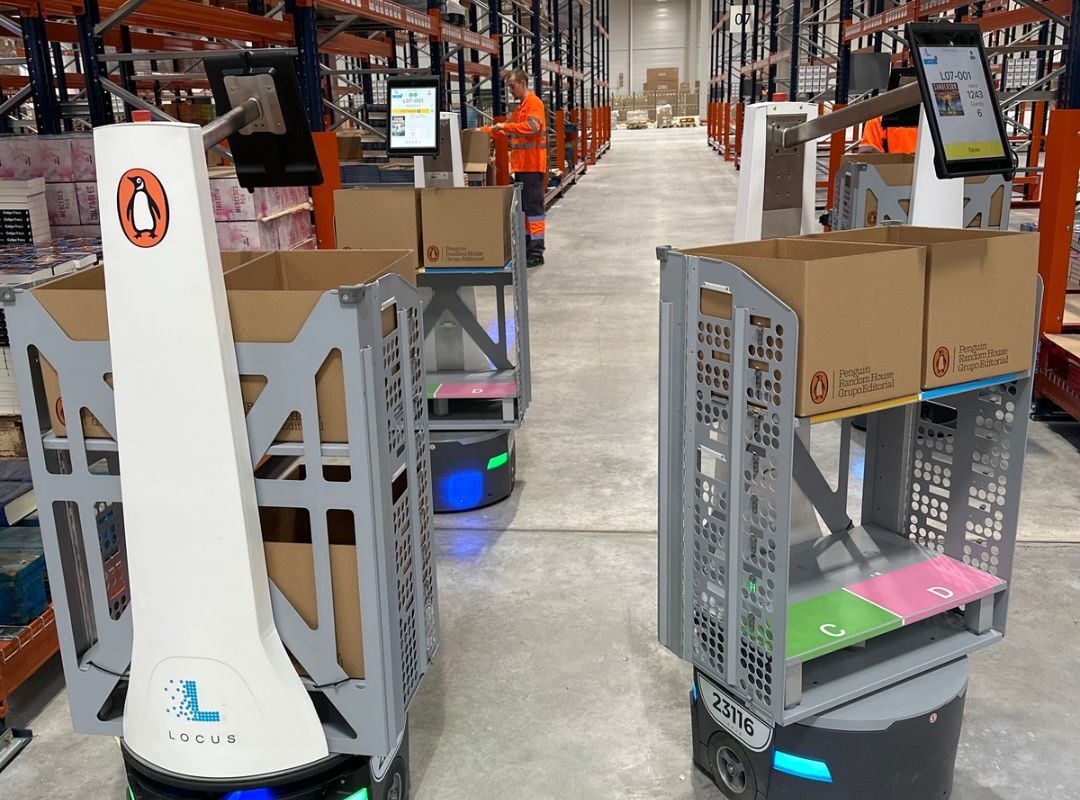
Penguin Random House Grupo Editorial (PRHGE) has shown how adaptable warehouse automation can support both productivity growth and operational continuity. At its Barcelona distribution operation, book-picking output has risen from 253 units per hour to more than 510.
The result is significant because book distribution combines a broad catalogue with uneven demand. Bookstore orders may include many different titles in small quantities, while seasonal peaks, promotions and new releases can quickly change the required picking mix. A fixed process designed around one demand pattern would therefore be difficult to sustain.
A scalable layer of automation
PRHGE deployed LocusONE in June 2022. Its original installation comprised 14 Locus Origin robots serving 100 SKU locations. The system has since expanded to 40 robots covering almost 1,000 locations, with monthly throughput exceeding 1.5 million units.
The expansion accelerated after PRHGE moved to a new Barcelona facility in October 2024. Within 10 months, SKU coverage had reached almost ten times its initial level. Rather than treating the relocation as a reason to replace the automation, the company transferred and redeployed the existing fleet.
Resilience through redeployment
That decision helped maintain fulfilment continuity while the new site was brought into operation. It also illustrates a practical aspect of automation resilience: equipment and workflows can be adjusted as the physical network changes, reducing the need for a complete redesign at every stage of growth.
The robotic fleet forms one part of a hybrid storage strategy. Fast- and medium-moving titles are handled through the Locus system, while high-density storage is used for slower-moving inventory. This division allows PRHGE to alter SKU allocation and available capacity as demand develops.
Martí Torra, Logistics and Distribution Director Spain at PRHGE, described the system as straightforward to implement and quick to scale. Denis Niezgoda of Locus Robotics said the operation demonstrates the value of infrastructure that can respond to changing SKU combinations and demand timing.
For industrial operators, the Barcelona example links digitalisation with resilience: productivity gains do not have to depend on a single large-scale transformation project. Modular automation can be expanded, reconfigured and moved with the operation. Further information is available from PRHGE and Locus Robotics.