Industrial decarbonisation depends on more than setting a carbon target. Companies also need a dependable operational baseline showing how freight emissions vary across carriers, modes, routes and shipment legs. Without that visibility, sustainability teams may spend significant time collecting data without giving planners a practical way to change outcomes.
Blue Yonder’s Logistics Emissions Calculator addresses this gap by combining several levels of input. Customers can use carrier-specific information where it exists, while modelled or default values can cover some missing details. The calculator accounts for equipment, transport modes and multi-leg movements, and is aligned with the Global Logistics Emissions Council (GLEC) Framework, which also supports ISO 14083.

Embedding sustainability in the digital workflow
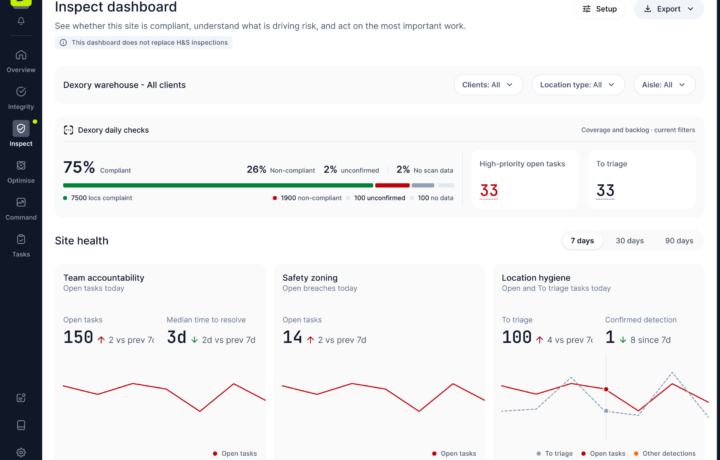
The industrial relevance lies in how the data is used. Rather than leaving emissions in a separate spreadsheet or reporting process, Blue Yonder has connected the calculator with its transportation management system and network products. Planners can see carbon alongside cost and delivery time, while control-tower users can follow emissions across planned, moving and delivered shipments.
This integration can reduce repeated requests to carriers and internal teams and make carbon information available at the point where decisions are made. It also supports comparisons between routes, modes and service providers. Companies may introduce an internal carbon value when assessing scenarios, making the effect of a mode shift or routing change part of the same decision as cost and service.
Operational efficiency and resilience
Potential measures include consolidating loads, shifting appropriate freight from air to ocean, deploying electric vehicles on suitable lanes and assessing alternative fuels. These choices involve trade-offs: an option with lower emissions may require more time or cost more. Digital visibility does not remove those constraints, but it enables deliberate decisions rather than assumptions.
Blue Yonder cites a life sciences manufacturer where route planning and load-utilisation improvements eliminated more than 1.4 million unnecessary truck miles each year. The example illustrates the connection between efficiency, cost and sustainability, although the mileage figure alone does not prove a specific carbon saving.
Data provenance remains essential for resilient industrial decision-making. Accuracy and Clarity features indicate what inputs produced a result and where primary data could improve confidence. The calculator can be deployed through the Blue Yonder software environment or as a standalone product using integrations or files.