Industrial logistics is placing simultaneous pressure on throughput, energy consumption and working conditions. Toyota Material Handling Europe’s latest warehouse vehicles address that combination with four compact electric models: the Optio L-series OSE100 and OSE100W for low-level order picking, and the Tracto S-series TSE300 and TSE500 for towing.
The launch is less about adding capacity in isolation than about refining the interface between people, vehicles and material flow. In tight warehouses, manoeuvrability and reduced operator movement can influence the efficiency of every picking cycle. At the same time, battery access, charging strategy and noise affect the practical sustainability of a fleet over its operating life.
Compact equipment for dense material flows
The two Optio vehicles have a 1,000 kg capacity and support picking up to the second level. The OSE100 has an elevating platform and an initial lift that raises the forks to an ergonomic working height. The OSE100W uses a walkthrough platform with a lift height of up to 1,195 mm, allowing bulky products to be picked onto the forks.
A three-wheel configuration supports turning in congested areas. Electronic steering options, heating and walkie controls can be selected for different operating environments. Walkie operation allows the truck to move while the worker walks beside it, limiting unnecessary boarding during repetitive tasks. The wider product family is presented in Toyota’s premium truck range.
Energy and human factors in the same specification
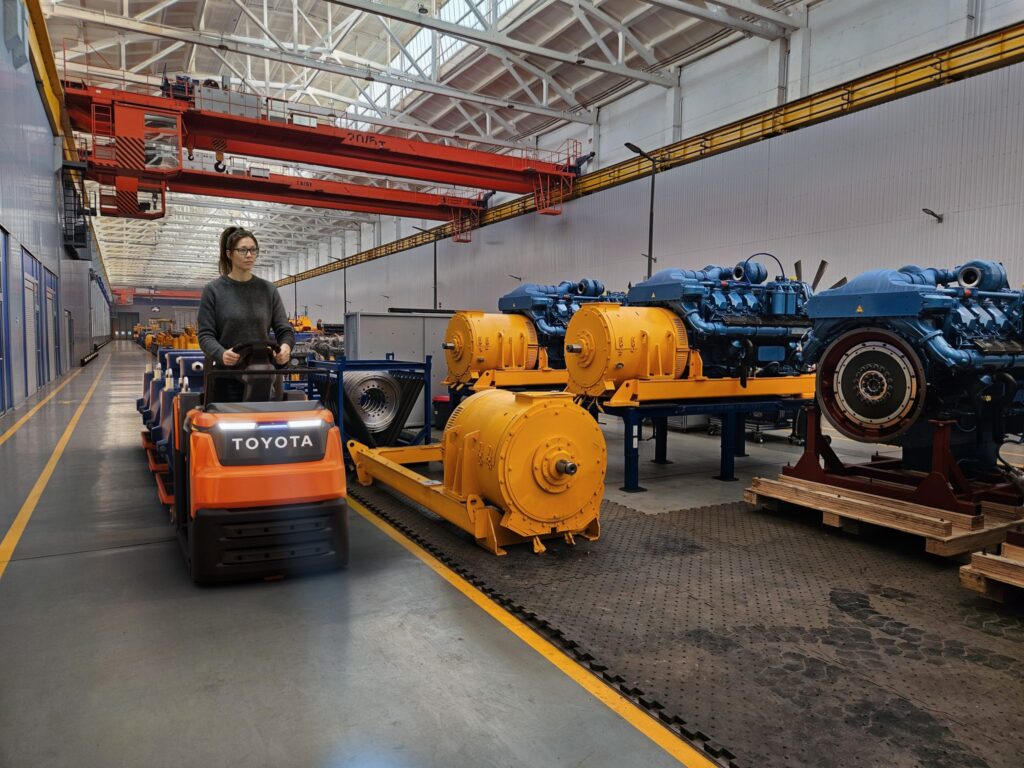
The TSE300 and TSE500 extend the concept to horizontal transport, with towing capacities of 3.0 and 5.0 tonnes and speeds of up to 12 km/h. Lithium-battery versions support opportunity charging, potentially helping sites keep vehicles in service for longer shifts. Standard inching buttons, optional mirrors, direction indicators and a Rockinger hitch address control and application flexibility.
Toyota has also revised the operator compartment, increasing entry width, adding integrated storage and simplifying battery access through a redesigned hood. Lower vibration and noise are intended to support sustained work, while warning-light options can improve visibility around moving equipment. According to ISO 23308-based evaluations, the OSE100 and OSE100W were recognised for energy consumption and noise performance.
Orders are expected to open in November, with production planned for the first quarter of 2027. The Optio OSE120CB is also scheduled to broaden the range. For industrial companies, the significance lies in a fleet proposition that treats energy efficiency, ergonomics and workflow continuity as connected operational variables rather than separate equipment features.