Warehouse resilience is often discussed in terms of automation, software and workforce capacity. Yet a smaller operational component—the industrial label—can also affect how quickly a site absorbs change. Label data links systems, products and physical movements, making the printing process part of the wider digital workflow.
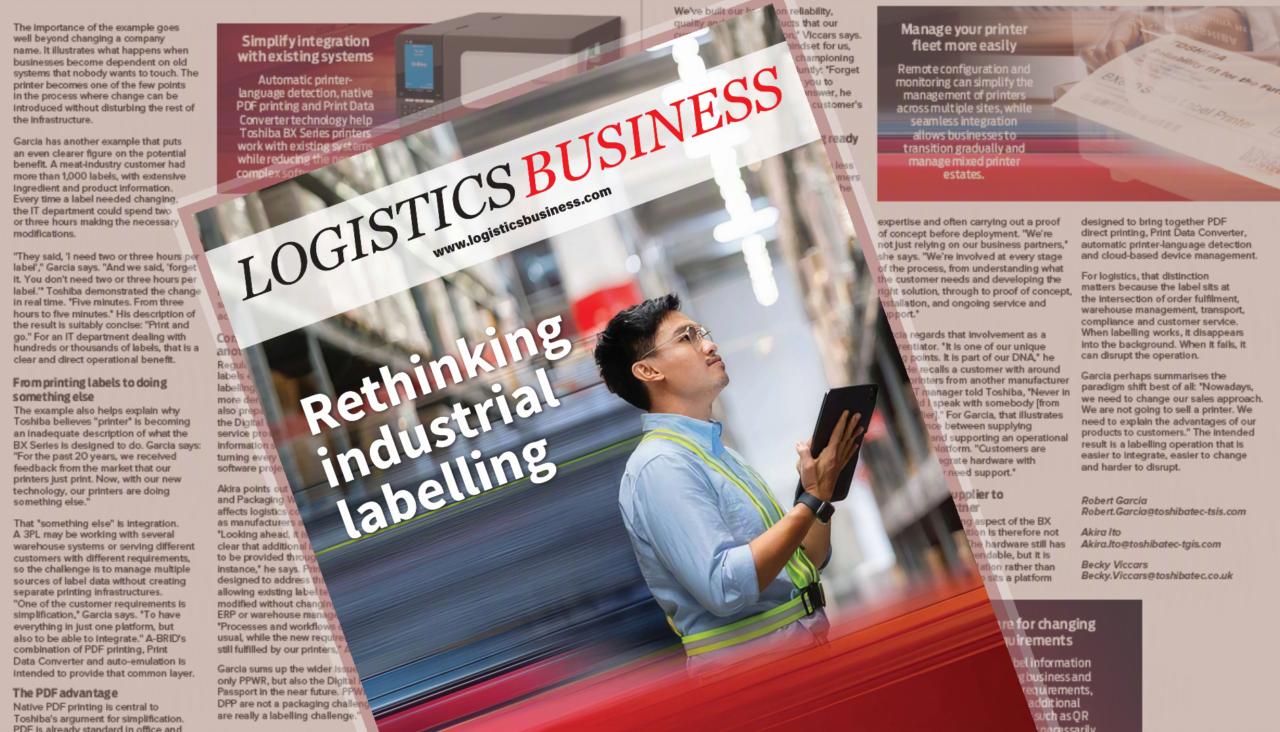
This issue is examined in Rethinking Industrial Labelling, a new eBook produced with Toshiba Tec. Peter MacLeod of Logistics Business discusses developments with Toshiba Tec experts, including native PDF printing, automatic printer-language detection and less complex system integration.
Adaptability beyond the printer
Traditional assessments focus on speed, reliability and physical durability. Those characteristics remain important, but a connected warehouse also needs printing infrastructure that can accommodate several warehouse management systems and changing regulatory or customer requirements.
Native PDF printing and automatic language detection are presented as ways to reduce the friction between business software and printing hardware. By limiting the need for specialised adjustments, such capabilities may make it easier to introduce new label formats or connect different sources of data.
Efficiency with a practical sustainability angle
The eBook gives a concrete example of a label modification completed in five minutes instead of taking up to three hours. That kind of reduction can help operations respond to change without extending configuration work or creating avoidable delays.
Material efficiency is another part of the discussion. In suitable applications, technology described in the publication can reduce ribbon consumption by up to 75%. Lower use of consumables may support both operating-cost control and more efficient resource management, although the result depends on the application.
The broader Industry 5.0 relevance lies in adaptability rather than automation for its own sake. A labelling system that is easier to integrate and modify can help people and digital systems work together more effectively. It also gives industrial businesses another lever for building processes that remain responsive as requirements evolve.